
Legal Sports Betting & Gambling Laws in Canada
Is Betting Legal in Canada?
Yes, betting is legal across Canada. On August 27, 2021, the Canadian government passed Bill C-218, which officially removed the federal ban on single-event sports wagering. While the law no longer prohibits betting on individual games at the national level, each province is responsible for deciding how to implement and oversee it. Under the Criminal Code of Canada, provinces hold the authority to establish their own gambling regulations. As a result, nearly all provinces and territories now provide some form of single-game wagering, though the details of rules and oversight vary from one jurisdiction to another.
When the legislation came into effect on August 27, 2021, several provinces were prepared to launch single-game betting immediately through their existing, government-regulated systems. Provinces such as British Columbia, Alberta, and Quebec already had provincially operated sportsbooks in place, managed by their respective lottery and gaming agencies. These platforms allow residents to bet both online and at retail locations. At that time, players in these provinces could only place wagers through these government-regulated services. To this day, Ontario is the only province that has expanded further by introducing a framework for private sportsbooks to operate legally within its territory.

Where to Legally bet on Sports in Canada
Sports betting is permitted across Canada, but the rules are not uniform. Unlike some other countries with nationwide systems, here every province decides for itself which forms of betting are allowed and through which platforms.
Retail betting refers to wagers placed face-to-face at casinos, racetracks, or other licensed venues. Online betting, by contrast, gives you the option to wager from anywhere, use digital payments, and often access features such as live streams or promotional offers.
Since the 2021 change to the Criminal Code, which opened the door to single-game betting, online opportunities have grown rapidly. Even so, the three northern territories — Yukon, Northwest Territories, and Nunavut — remain limited to the Sport Select program run by the Western Canada Lottery Corporation. Residents there can prepare slips online but must still complete purchases at a retail outlet.
Provincial Betting Authorities
Here is a province-by-province overview of the organizations that regulate sports betting and the official platforms currently in use:
| Province/Territory | Regulator | Official Sportsbook(s) |
| Alberta | Alberta Gaming, Liquor & Cannabis | Play Alberta, Sport Select |
| Ontario | Alcohol and Gaming Commission of Ontario | Proline, private operators |
| British Columbia | British Columbia Lottery Corporation | PlayNow |
| Manitoba | Manitoba Liquor & Lotteries (via BCLC) | PlayNow |
| Québec | Loto-Québec | Mise-o-Jeu |
| Saskatchewan | Saskatchewan Indian Gaming Authority (via BCLC) | PlayNow |
| Newfoundland & Labrador | Atlantic Lottery Corporation | Proline |
| Nova Scotia | Atlantic Lottery Corporation | Proline |
| Prince Edward Island | Atlantic Lottery Corporation | Proline |
| New Brunswick | Atlantic Lottery Corporation | Proline |
| Yukon | Lotteries Yukon / WCLC | Sport Select – retail only |
| Northwest Territories | WCLC | Sport Select – retail only |
| Nunavut | WCLC | Sport Select – retail only |




Legal Online Betting by Canadian Province
While every Canadian province and territory has legalized some form of retail (in-person) betting, not all of them provide access to online sportsbooks. This is an important distinction to keep in mind when looking at the legal betting landscape in Canada.
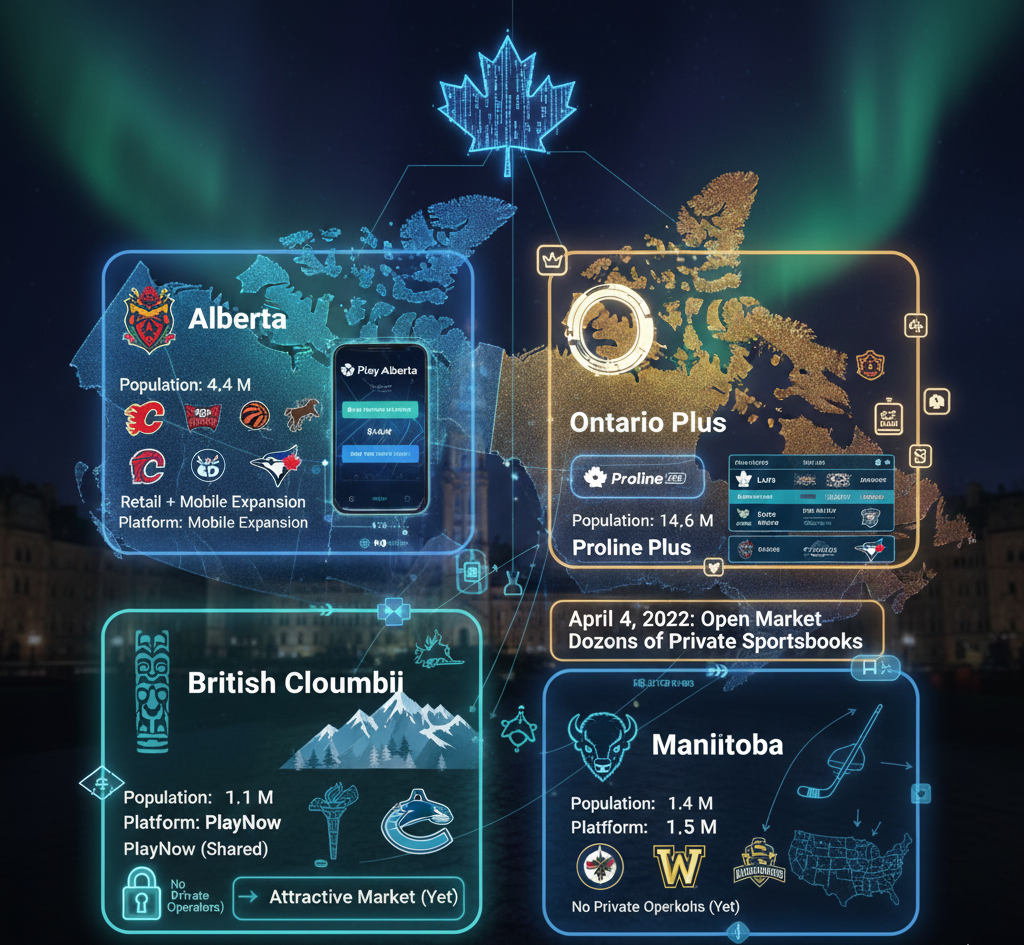
Alberta
- Population: about 4.4 million
- Provincial platform: Alberta Gaming, Liquor and Cannabis — Play Alberta
- Major teams: Calgary Flames (NHL), Edmonton Oilers (NHL), Calgary Roughnecks (NLL), Calgary Stampeders (CFL), Edmonton Elks (CFL)
Alberta is home to several professional sports clubs and the famous Calgary Stampede. It is also a destination for winter sports such as alpine skiing. Regulators are considering the introduction of two private operators for retail wagering, with potential mobile expansion in the future.
Ontario
- Population: about 14.6 million
- Provincial platform: Ontario Lottery and Gaming Corporation — Proline Plus
- Major teams: Toronto Maple Leafs (NHL), Toronto Argonauts (CFL), Toronto Raptors (NBA), Toronto Rock (NLL), Toronto FC (MLS), Ottawa Senators (NHL), Toronto Blue Jays (MLB), Hamilton Tiger-Cats (CFL), Ottawa Redblacks (CFL)
Ontario is Canada’s most populous province and the country’s largest sports market. It is home to the greatest number of professional and amateur clubs. Beyond OLG’s PROLINE games, the province launched a regulated iGaming market on April 4, 2022, opening the doors to dozens of private sportsbooks. Other regions are watching closely to see if this open model will be successful for them as well.
British Columbia
- Population: about 5.1 million
- Provincial online platform: British Columbia Lottery Corporation — PlayNow
- Major teams: Vancouver Canucks (NHL), Vancouver Whitecaps (MLS), Vancouver Warriors (NLL), BC Lions (CFL)
British Columbia remains an attractive market for private operators, but the provincial government has not yet moved toward allowing them in. Vancouver hosted the 2010 Winter Olympics and continues to support an active sports scene. Fans in the province also follow teams from nearby Seattle.
Manitoba
- Population: about 1.4 million
- Provincial platform: Partnership through BCLC — PlayNow
- Major teams: Winnipeg Jets (NHL), Winnipeg Blue Bombers (CFL)
Sports life in Manitoba centers around Winnipeg, a province known for producing top hockey players and curlers. Because of its location near Minnesota and South Dakota, many fans also follow American teams from those states.
Quebec
- Population: about 8.6 million
- Provincial platform: Loto-Québec — Mise-o-Jeu
- Major teams: Montreal Canadiens (NHL), Montreal Alouettes (CFL), CF Montreal (MLS)
Quebec is a French-speaking province with a rich sporting history. It currently has three professional teams, but in the past was also home to the Montreal Expos (MLB, relocated to Washington in 2004) and Quebec Nordiques (NHL, later became the Colorado Avalanche).
Saskatchewan
- Population: about 1.2 million
- Provincial platform: Partnership through BCLC — PlayNow
- Major teams: Saskatchewan Roughriders (CFL), Saskatchewan Rush (NLL)
Saskatchewan is known for having some of the most passionate fans in the Canadian Football League. The province also has deep curling traditions. In November 2022, the Saskatchewan Indian Gaming Authority, with support from BCLC, launched a new online sportsbook.
Atlantic Provinces
- Population: about 2.5 million (Nova Scotia, Prince Edward Island, Newfoundland and Labrador, New Brunswick)
- Provincial platform: Atlantic Lottery Corporation — Proline Plus
- Major teams: Halifax Thunderbirds (NLL)
Nova Scotia is the largest of the Atlantic provinces and a hotbed for junior hockey. Legendary NHL players like Sidney Crosby and Nathan MacKinnon were born here. While the region does not have an NHL franchise, many fans follow Boston teams closely due to geographical proximity.
Northwest Territories, Nunavut, and Yukon
- Population: about 130,000
- Provincial platform: Sport Select (WCLC)
- Major teams: none
Canada’s northern territories cover vast areas with unique cultures and sporting traditions. Despite their smaller populations, they have produced notable athletes. Dylan Cozens from Yukon became the highest NHL draft pick from the region and now plays for the Buffalo Sabres. Jordin Tootoo, from Rankin Inlet, Nunavut, is celebrated as the first Inuk to play in the NHL, making him a source of pride for the people of Nunavut.

What is the Legal Gambling age in Canada?
In Canada, there isn’t one single legal age for gambling. In some provinces you can play at 18, while in others the minimum is 19. Since each province sets its own rules, the requirement depends on where you live. It also varies by the type of activity. Whether you want to enter a casino, buy a lottery ticket, play online, or take part in provincial draws, you need to be of legal age in your province.
Online betting includes both provincially regulated platforms — such as PlayNow.com, Proline, or Play Alberta — and private sportsbooks that are officially licensed in Ontario. If you live outside Ontario and plan to bet online, you should carefully check the rules of the website you intend to use. Many so-called “grey market” sportsbooks are based outside Canada, which means their age requirements may differ.
To make sure you qualify, take a look at the table below that shows the legal gambling age for each province and territory.
| Province/Territory | Gambling Age |
| British Columbia | 19 |
| Alberta | 18 |
| Saskatchewan | 19 |
| Manitoba | 18 |
| Ontario | 19 |
| Quebec | 18 |
| Newfoundland and Labrador | 19 |
| Nova Scotia | 19 |
| Prince Edward Island | 19 |
| New Brunswick | 19 |
| Yukon | 19 |
| Northwest Territories | 19 |
| Nunavut | 19 |
Timeline of Gambling Laws in Canada
1892: Gambling in Canada remained largely unregulated until 1892, when the federal government introduced the Criminal Code of Canada. This new legislation banned all forms of sports betting and most gambling activities, with only a few exceptions — such as horse race pools and small games at fairs or carnivals.
1969: The Criminal Code was revised in 1969 to permit low-stakes gambling for charitable and church fundraising. This opened the door to Bill C-150, which allowed both federal and provincial governments to operate lotteries for funding specific projects. One of the first major examples was raising money for the 1976 Summer Olympic Games in Montreal.
1985: A further amendment to the Criminal Code in 1985 gave provinces full control over lotteries and gaming schemes. This included lottery games offered through computers, video terminals, and slot machines. Provinces also gained the authority to provide parlay betting on major North American sports. At that time, moneyline markets were the only option, and every parlay ticket required at least three selections.
1992: In 1992, provinces rolled out their own parlay products such as Proline, making them available at retail outlets to combat illegal bookmaking. Around the same period, the growth of the internet introduced Canadian players to offshore “grey market” operators based in places like Costa Rica, Gibraltar, and the Isle of Man. These platforms attracted attention by offering larger betting markets, higher stakes, and bonuses that were unavailable domestically.
2012 – 2016: Lawmakers introduced several bills aimed at legalizing single-event betting and creating a taxable domestic market. In 2012, Bill C-290 passed in the House of Commons but was rejected by the Senate in 2015. A second attempt the following year was also unsuccessful.
2020 – 2021: On February 25, 2020, Conservative MP Kevin Waugh introduced Bill C-218, designed to legalize single-game wagering and hand regulation over to the provinces. The bill later gained sponsorship in the Senate from Senator David Wells and was ultimately passed, taking effect on August 27, 2021. This marked the official decriminalization of single-event betting across Canada.
2022: Ontario became the first — and so far only — province to open its doors to private sportsbook operators, creating a regulated competitive market alongside its provincial lottery offerings. While each province continues to “conduct and manage” gambling under its own laws, Ontario’s model stands out as the most open framework in the country.

Why Regulate Online Sports Betting in Canada?
Online wagering has quickly become the most common way Canadians gamble. In 2020 alone, it was estimated that more than $14 billion was spent on offshore sites operating outside Canadian law. Ontario’s regulated sports betting market, which officially opened on April 4, 2022, was designed to change that by giving you — the bettor — a safe and legal alternative while also allowing the province to benefit from the industry’s revenue.
When you place bets with an unregulated operator, you are taking on risks that may not be obvious. There is no assurance that your deposits are secure, that your personal data is handled responsibly, or that the odds you see are fair. In some cases, your winnings may be delayed or not paid at all. Many offshore websites are even run by companies operating outside any legal framework, leaving you with no recourse if something goes wrong.
By contrast, licensed sportsbooks in Ontario must comply with strict oversight. They also pay about 20% tax on gaming revenue, which means part of the money you deposit goes back into funding services and programs in the local community. This is one of the main reasons why experts believe other provinces should move toward regulation as well: it protects you as a bettor while also ensuring that gambling dollars contribute to Canada’s economy rather than flowing overseas.
In-Person Casino Sports Betting Options
Since November 2022, in-person sports betting has been fully legal in Ontario. On October 31, 2022, the Ontario Lottery and Gaming Corporation (OLG) confirmed it had reached a compliance agreement with the provincial government, officially opening the door for retail single-game wagering.
Only hours after that announcement, Great Canadian Entertainment (GCE) — which operates 25 gaming and hospitality venues across Canada — revealed that it was accepting retail sports wagers at 10 of its Ontario casinos. Four of those casinos — Great Blue Heron Casino & Hotel, Pickering Casino Resort, Elements Casino Brantford, and Shorelines Casino Belleville — went a step further by introducing dedicated sportsbook lounges. These lounges allow you to watch live games, order food and drinks, and place bets at on-site kiosks.
Six additional GCE locations, including Casino Woodbine, Shorelines Casino Peterborough, Shorelines Casino Thousand Islands, Elements Casino Mohawk, Elements Casino Grand River, and Elements Casino Flamboro, now provide sportsbook kiosks within their existing gaming floors.
Just a few days later, on November 3, 2022, Caesars Windsor opened 10 sports betting kiosks on its property. A full retail sportsbook is also under construction there, with completion expected early the following year. On November 16, 2022, both Fallsview Casino Resort and Casino Niagara launched their kiosks and lounge spaces for sports betting.
Outside Ontario, expansion is also on the horizon. The Saskatchewan Indian Gaming Authority (SIGA) has announced plans to open a dedicated sportsbook lounge at one of its seven casinos in Saskatchewan during 2023.